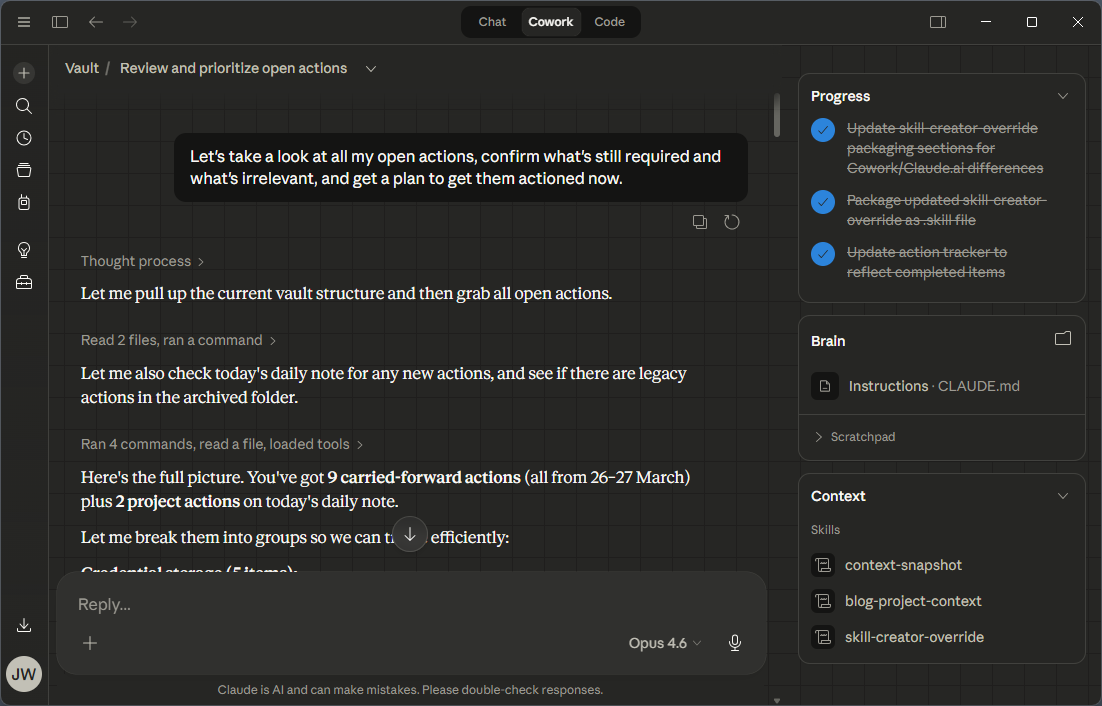
I started using Claude Cowork about three weeks ago. Most of the coverage is by devs, written for other devs. I'm not one. I'm a non-developer who builds personal AI infrastructure (automations, skills, pipelines) using Claude and n8n. Cowork changed what I can delegate.
What Cowork actually is
Regular Claude chat has connectors, projects, and the ability to take actions. You're still the orchestrator though. You prompt, Claude responds, you prompt again. Multi-step work means you're managing context, sequencing tasks, keeping track of what's done.
Cowork removes that layer. You describe the outcome, it plans the steps and takes action using your local files, connectors, and skills.
The local file access might put some knowledge workers off. Plenty of people don't work in local files, they use Notion, OneDrive, SharePoint. Cowork still connects to all of those through connectors and skills. The connectivity is the same as regular Claude. The difference is the autonomy.
If you don't use local files now, that's fine. Local file access serves two roles: output destination and memory layer. It's somewhere to save outputs before publishing them elsewhere, and it's where persistent context lives between sessions. I use Obsidian because CLAUDE.md files give you project rules, skill definitions give you reusable workflows, and structured notes get read automatically at the start of each session. No re-explaining.
Features
Connectors and file access are the foundation. Claude pulls data from external services, processes it, saves results to your local folders or back to those services. I pointed it at my blog content folder and my Obsidian vault. "Check my post ideas and score them against current trends." It reads the files, does the research, updates the scores, saves the changes. An hour of manual prompting collapsed to ten minutes unsupervised.
Scheduled tasks run work inside a specific set of files on your machine. I've got a few going. The first one I set up, probably the first one everyone sets up, is a daily note pipeline. Every morning at 7am it gathers news using a skill I developed, checks my calendar and tasks through whatever service I use via connectors, reviews project activity, and assembles everything together. It's waiting in my vault when I sit down.
Computer use is the newest and roughest. Claude can see your screen, click buttons, navigate applications. Simple sequences work. Anything requiring visual judgment breaks down. I haven't used it properly in my workflow yet, mostly testing and as a fallback when no connector exists. Two things worth knowing: it burns through tokens fast, and it tends to default to screen interaction even when connectors exist. You need to be explicit in your CLAUDE.md files and global rules to prevent that. Still in preview.
Dispatch connects Cowork to your phone via the Claude app and lets you send tasks while it's running on your laptop. I use it when I think of something away from my desk. "Save a summary of the latest MCP research to my blog folder." By the time I sit down, the file's there. You need to be specific though. There's no folder or project selector, so vague instructions go to the default or wherever Cowork decides. Mentioning paths helps. It also introduces the 2am problem. If I think of an idea in the middle of the night, I can dispatch it to Cowork when I should probably just be sleeping.
What it replaces
Before Cowork, getting the same output from Claude chat meant a lot more from you. Managing context across conversations, putting things in projects for persistence, starting fresh chats when context got bloated with tool calls, copying outputs to the right place. The more complex the task, the more time spent managing Claude rather than working. Cowork is the orchestration layer that was missing.
I also use n8n for complex cross-service integrations, and that hasn't changed. Complex logic still belongs there. But file-based work and connected-service tasks on a cadence moved to Cowork entirely.
What's still rough
Cowork is still in preview, and it shows.
Token consumption is aggressive. Pro limits get hit fast. Max does better but still feels it. Computer use makes it worse. One browser automation can burn more tokens than a full text-based pipeline. If you're running scheduled tasks and doing interactive work on the same day, you'll hit the ceiling.
Your machine needs to stay on. There's no server-side execution. Your computer is the infrastructure. Claude has settings to keep your machine awake, which works if you're at a desk, but scheduled tasks won't run if you're moving around with the lid closed.
Microsoft just launched Copilot Cowork into their Frontier programme. Built with Anthropic, essentially the same concept but in the Microsoft ecosystem, running server-side. Tasks continue whether your PC is on or not. Very early days, currently limited to Frontier early access and the new E7 licence tier, but for Microsoft-embedded workers it could eliminate the desktop dependency once generally available.
Memory is project-scoped, not global. Standalone conversations start fresh. That's where your file system comes in. CLAUDE.md files for project rules, skill definitions for reusable workflows, structured notes that Cowork reads at session start. I keep a subfolder in each project that's Claude's own space. It records what it needs for future sessions. Doesn't need to be human-readable. My own notes sit separately. They all come together when needed. Auto-memory helps within sessions, but real persistence is your file system as a knowledge base.
Why this matters
The agent conversation has been mostly about devs and enterprise. Cowork bridges the gap for people who could benefit from agentic workflows but live in SaaS tools, not IDEs. Connectors handle the service access. Local files handle the orchestration and memory underneath.
Telling an AI to "handle this" now works for repeatable knowledge work: analysis tasks, research, formatting, anything that needs an output and has clear inputs. Instead of prompting, copying, starting new chats, and assembling results manually, Cowork does it in a single flow. You check the results later. Not for everything. But for enough daily tasks that my workflow shifted from "use Claude when I need help" to "assign Claude work and check the results."