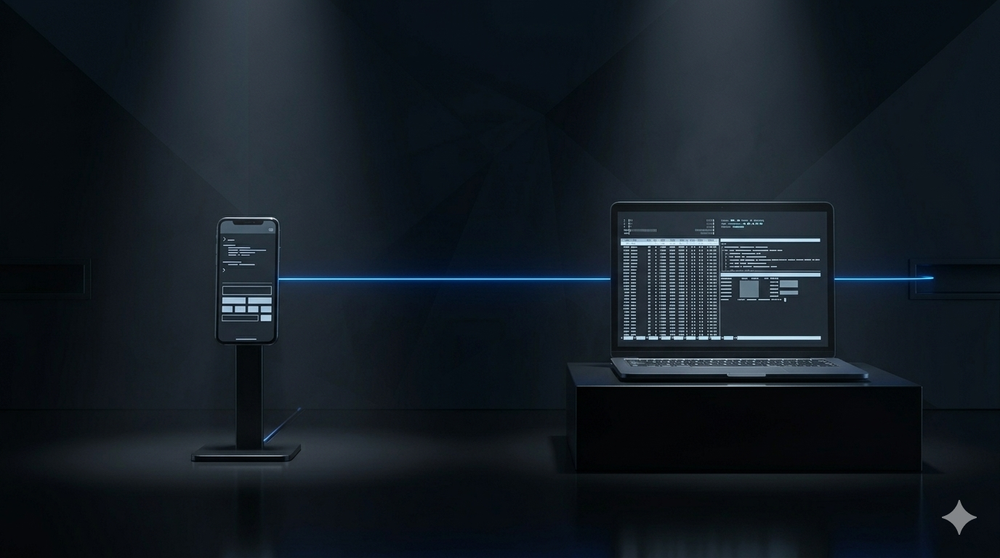
My daily pattern with Dispatch goes like this: I'm on my phone at around 7am, before I've touched my laptop. I send a command: run the consulting follow-up check, kick off the blog pipeline review, whatever's sitting in my head. My desktop picks it up and runs it. By the time I'm at my desk an hour later, there's a result waiting.
I didn't think much of this until Codex Mobile launched on 14 May and I watched the demo. Same pattern, different product. Phone as command surface. Execution on a local machine. Result to review when you get there.
Codex Mobile isn't a mobile code editor, which I think is what most people expected. There's no code running on your phone, no editor, no diff view in the traditional sense. What you get is a control surface for Codex running on your Mac. You send tasks, approve the steps it wants to take, redirect when it's going wrong. The actual execution stays on the desktop. OpenAI shipped it via the ChatGPT app on 14 May, iOS and Android, preview on all plans. Windows wasn't at launch.
The approval loop is the interesting part. Before Codex runs a significant step, it surfaces a summary to your phone and waits. You can approve, redirect, or stop it. So you're not just firing off tasks and ignoring them. You're handling the decision points from wherever you are, then leaving the actual work to run on hardware that can actually run it.
The Dispatch feature in Cowork works on the same logic. You're the remote operator. The desktop is where execution lives. Your phone is where you read summaries, issue corrections, decide what happens next.
I don't think either team copied the other. They both looked at what mobile can realistically do in an AI workflow and landed on the same answer: the phone is good at low-latency human judgment, and bad at sustained computation. Stop trying to make it do both.
What that implies about context is the part I keep coming back to. For either of these products to work the way they do, there has to be a thread, a shared memory that exists independently of which device is holding it. The phone doesn't hold the context. The desktop doesn't hold it. Something else does, and both surfaces access it.
This appears to be where AI interaction design is heading. Not an app you open on one device, but a persistent thread you connect to from wherever you are. The relationship is with the thread, not the channel.
I've been running my own stack like this informally for a while. My notes vault is the persistent layer. Claude sessions come and go, but the vault is always there: notes, decisions, project state. Dispatch is the mobile surface. Cowork sessions are the desktop surface. They don't share real-time state; there are gaps, sync delays, sessions that don't know what the previous one did. But the shape of the thing is right. One thread, multiple surfaces.
What Codex Mobile and Dispatch both suggest is that this is becoming an intentional design decision rather than something you have to engineer around yourself. The AI lives in the thread. You access it from wherever you are.
There are real gaps in the current implementations. Context handoff between sessions is still rough. You have to be deliberate about what you carry forward, and most products don't make this easy. Memory across devices is handled inconsistently. Both products surface an approval step before significant actions, but the definition of significant varies and there's no shared standard yet.
The single-thread model also raises questions about persistence that nobody's really answered yet. If the thread is the relationship, what happens when it ends? Right now, every closed session is a small amnesia. That's fine for tasks. It's a limitation for anything that looks like an ongoing collaboration, which is where a lot of this seems to be going.
I'd also be cautious about reading too much into the convergence. Both Codex Mobile and Dispatch are early. The pattern appears right, but the implementation is still being figured out, and it's possible both products pivot as they learn more about how people actually use them.
That said: if you're running a personal AI stack, the framing is worth adopting. Phone as control surface, desktop as execution, persistent context as connective tissue. The products that will feel native in two or three years are the ones building on this pattern now. Two teams found it independently. That's as close to a signal as we get at this stage.
If you're working out how the pieces of an AI stack should connect, that's the kind of architecture work I do. consulting@joshwickes.com